This post may contain affiliate links. If you purchase through one of these links, I may earn a small commission at no additional cost to you.
If you spend enough time sewing, you eventually develop a collection of tools you simply don’t want to work without. Some sewing tools are nice to have, while others quickly become part of your everyday routine.
Over the years, I’ve tried plenty of sewing supplies, gadgets, cutters, markers, and scissors. Some have stayed tucked away in a drawer, but a few have earned a permanent place within easy reach of my sewing machine.
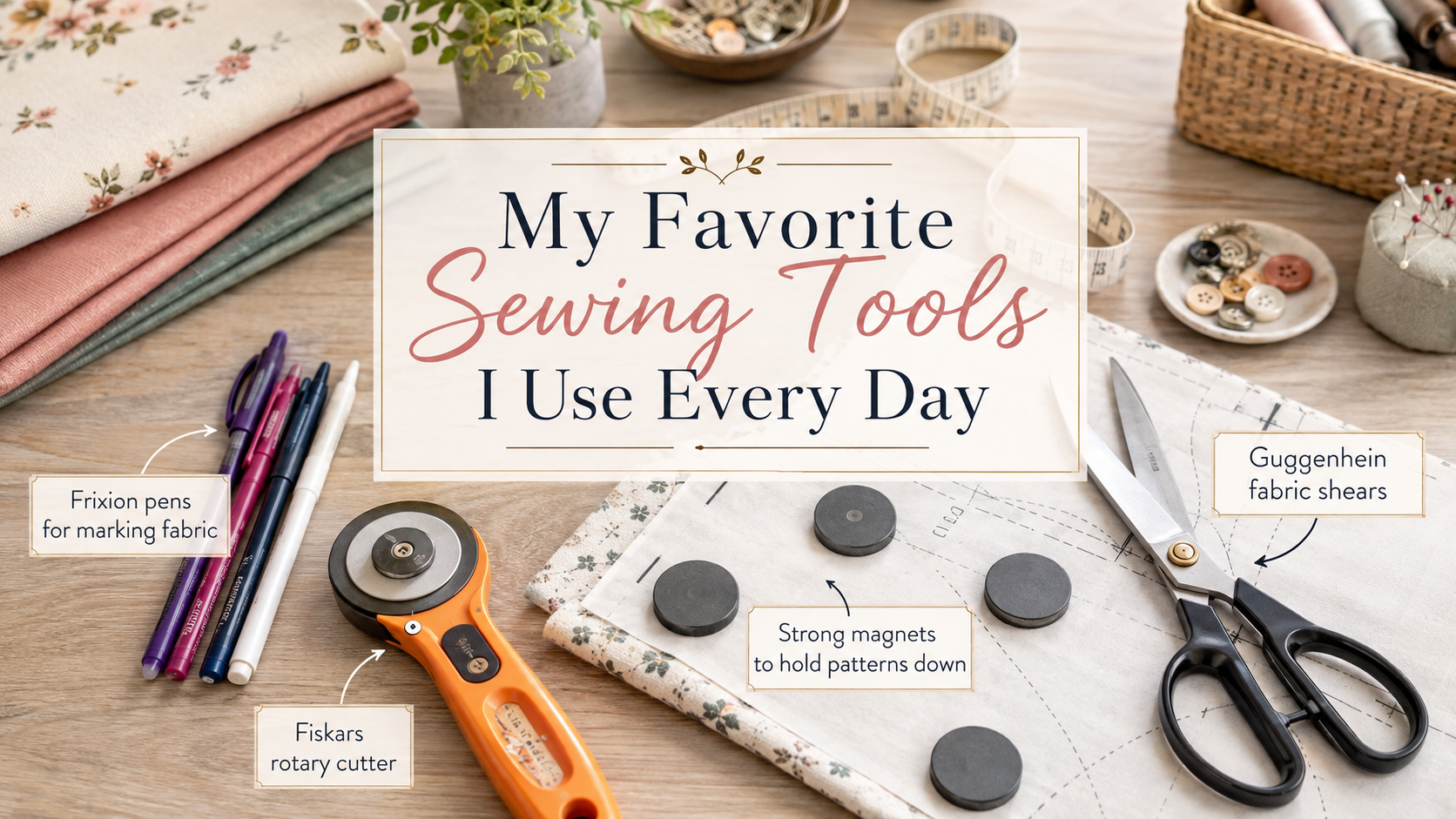
Today, I’m sharing some of my favorite sewing tools that I use all the time: Frixion pens, a Fiskars rotary cutter, strong magnets for holding patterns in place, and Guggenhein fabric shears.
These tools make cutting, marking, and preparing my sewing projects faster and easier—and anything that makes sewing a little more enjoyable is a win in my book.
1. Frixion Pens for Marking Fabric
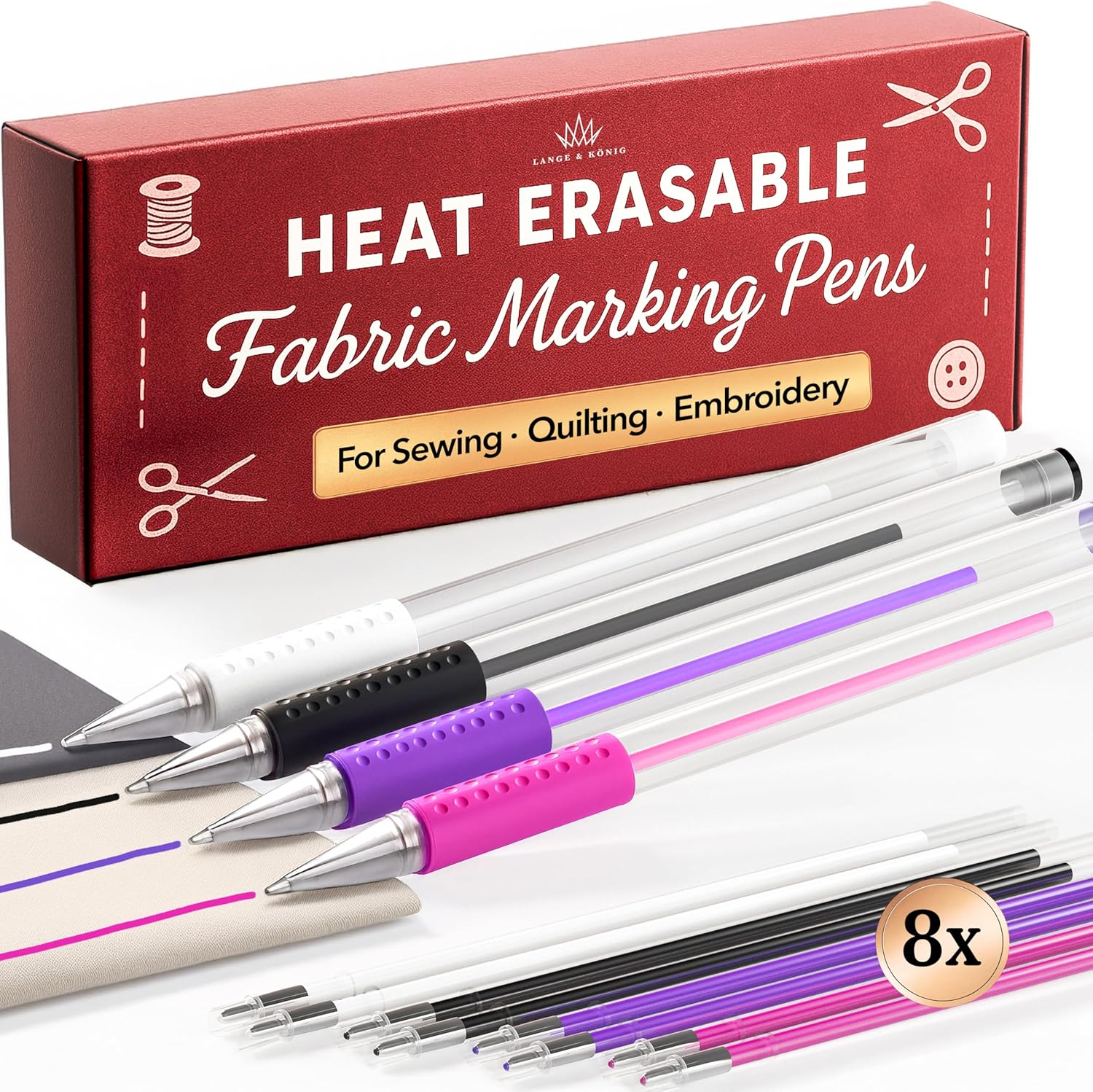
One of the tools I reach for most often is a Pilot Frixion pen.
Although these pens weren’t specifically designed as sewing tools, many sewists use them for temporarily marking fabric. I like them because they make it incredibly easy to create thin, precise lines.
I use Frixion pens for marking things like:
- Seam placement
- Pocket locations
- Button placement
- Pleats
- Darts
- Quilting lines
- Pattern markings
- Matching points
- Placement lines for appliqué or embroidery
The lines are easy to see while I’m working, which is especially helpful when I need more precision than I can get from tailor’s chalk.
One of the biggest reasons I like using Frixion pens is that the marks typically disappear when heat is applied. A quick press with an iron can make the markings seem to vanish.
A Word of Caution About Frixion Pens
I always recommend testing a Frixion pen on a scrap of your fabric before marking your actual project.
Heat can make the ink disappear, but depending on the fabric and environmental conditions, faint markings or discoloration may remain or become visible again. Because of that, I avoid using them in highly visible areas unless I have tested the fabric first.
For projects where the markings will eventually be hidden inside a seam or covered by another fabric piece, however, they are one of my favorite marking tools.
2. My Fiskars Rotary Cutter
My Fiskars rotary cutter is another sewing-room staple.
Before I started using a rotary cutter regularly, I relied almost entirely on fabric scissors. While scissors definitely still have their place, a rotary cutter can make certain cutting jobs so much faster.
I especially love using mine when I need to cut:
- Long straight strips
- Rectangles
- Squares
- Quilting pieces
- Bag pieces
- Binding
- Multiple pieces with straight edges
When paired with a cutting mat and acrylic ruler, a rotary cutter makes it much easier to get clean, straight cuts.
That precision makes a difference later when I’m sewing. Accurate cutting makes it easier to line up seams, match pieces, and get professional-looking results.
Keep Those Blades Sharp
One lesson I learned quickly is that rotary cutter blades make a huge difference.
If I find myself pressing harder and harder to get through my fabric, it usually means it’s time to replace the blade.
A sharp blade should glide through the fabric rather than forcing you to repeatedly cut over the same area.
I also make it a habit to close the blade guard whenever I put my rotary cutter down. Rotary blades are extremely sharp, so this is one sewing tool I’m especially careful with.
3. Strong Magnets for Holding Patterns Down
This may be one of the simplest tools in my sewing room, but it is also one of my favorites.
Strong magnets make fantastic pattern weights.
Instead of pinning a pattern piece to fabric over and over again, I can place magnets around the edges of the pattern and start cutting.
Of course, magnets work best when you have a magnetic surface underneath your cutting area. Depending on your setup, you can place a thin steel sheet underneath your cutting mat or use another compatible magnetic cutting surface.
I especially appreciate magnets when I’m working with patterns that have several pieces.
They help keep everything from shifting while I trace or cut.
Why I Love Using Magnets
Magnets are:
- Quick to position
- Easy to move
- Reusable
- Small enough to store easily
- Helpful for avoiding unnecessary pin holes
- Great for holding pattern pieces flat
They can also save quite a bit of time.
Instead of carefully pinning around the entire pattern, I can position a few strong magnets, make sure everything is smooth, and start cutting.
It’s one of those small sewing-room tricks that makes the whole process feel easier.
4. Guggenhein Fabric Shears
A good pair of fabric scissors can completely change your cutting experience, and my Guggenhein fabric shears are one of the tools I enjoy using most.
There is something incredibly satisfying about having scissors that cut cleanly through fabric without chewing, snagging, or forcing you to stop every few inches.
I use my fabric shears whenever a rotary cutter isn’t the best option.
They’re especially useful when cutting:
- Curves
- Small pattern pieces
- Detailed shapes
- Clothing patterns
- Notches
- Tight corners
- Areas where I want more control
Good fabric shears should feel comfortable in your hand and cut smoothly from the base of the blade all the way to the tip.
The Most Important Rule in My Sewing Room
My fabric shears are for fabric only.
Not paper.
Not cardboard.
Not opening packages.
Not cutting tape.
Fabric only.
Using fabric scissors on paper and other materials can dull the blades much faster. If you invest in a good pair of shears, keeping them reserved for fabric will help them perform better for much longer.
If other people have access to your sewing room, labeling your fabric scissors isn’t a bad idea either!
Do You Need Expensive Sewing Tools?
Not necessarily.
You can create beautiful sewing projects with very basic supplies. You don’t need every new gadget that appears in the sewing aisle.
I would much rather have a small collection of dependable tools that I use constantly than a sewing room filled with gadgets I rarely touch.
When deciding whether to buy a sewing tool, I usually ask myself:
Will this make something I already do regularly easier, faster, or more accurate?
If the answer is yes, then it may be worth adding to my sewing room.
The tools I’ve shared here have earned their place because I genuinely use them.
My Everyday Sewing Tool Favorites
If I had to narrow my everyday sewing tools down to four favorites, they would be:
Frixion pens for quick and precise fabric marking.
My Fiskars rotary cutter for fast, accurate cutting.
Strong magnets for keeping pattern pieces securely in place.
Guggenhein fabric shears for smooth, controlled fabric cutting.
None of these tools actually do the sewing for me, of course, but they make the preparation process so much easier.
And when your fabric is marked accurately, your pattern isn’t shifting, and your pieces are cut cleanly, everything that comes afterward tends to go much more smoothly.
Build a Sewing Kit That Works for You
Every sewist eventually develops a list of favorite tools.
What works perfectly for me might not be exactly what works for someone else, and that’s part of the fun of creating your own sewing space.
Try different tools. Pay attention to which ones you constantly reach for. Invest in better versions of the tools you use most often.
Before long, you’ll have your own collection of sewing-room favorites that make sitting down to sew even more enjoyable.
What sewing tool could you absolutely not live without?
I’d love to know which tools have earned a permanent spot next to your sewing machine.